Stoichiometric Constraints
The most flexible method of imposing stoichiometric constraints in CLEASE is to use linear systems of equations. Here, you can find a list of examples of how different constraints can be imposed. In CLEASE a linear system of equations with the structure shown below
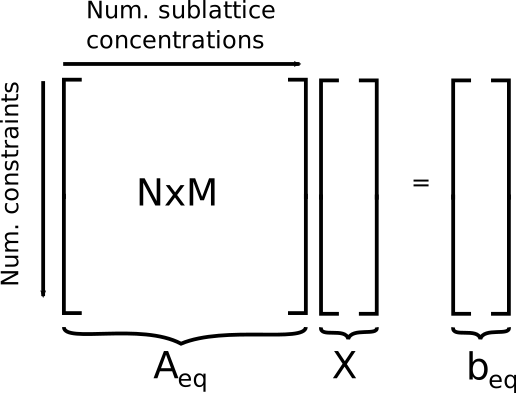
The number of sublattice concentration is simply the length of the flattened version of basis_elements that is passed to the Concentration class. Therefore, if basis_element = [['Au', 'Cu'], ['Cu', 'X]] there will be to Cu concentrations you can restrict; one for each sublattice. The total number of sublattice concentrations in the example above is 4. Hence, all rows of the matrix has 4 columns. CLEASE has two types of constraints: equality and lower bound. Equality constraints are passed via A_eq and b_eq arguments in the Concentration class, and lower bound constraints are passed via A_lb and b_lb. For lower bound constraints, the equality sign in the figure is replaced by a larger or equal than-symbol. Note that upper bound constraints can trivially be converted to a lower bound constraint by multiplying the equation by -1. Finally, the example below shows how you can generate random concentrations satisfying your constraints. The list passed to the function is the number of sites in each sublattice.
1import numpy as np
2np.random.seed(0) # Set a seed for consistent tests
3from clease.settings import Concentration
Binary System With One Basis
1basis_elements = [['Au', 'Cu']]This is a system where we have the basis_elements=[['Au', 'Cu']].
1. Force the Au concentration to be equal to the Cu concentration
1A_eq = [[1.0, -1.0]]
2b_eq = [0.0]
3conc = Concentration(basis_elements=basis_elements, A_eq=A_eq, b_eq=b_eq)
4for i in range(10):
5x = conc.get_random_concentration([20])
6assert np.abs(x[0] - x[1]) < 1e-10
2. Force number of Au atoms to be larger than 12
1A_lb = [[20, 0.0]]
2b_lb = [12]
3conc = Concentration(basis_elements=basis_elements, A_lb=A_lb, b_lb=b_lb)
4for i in range(10):
5x = conc.get_random_concentration([20])
6assert round(20*x[0]) >= 12
Two sublattices
1basis_elements = [['Li', 'V'], ['O', 'F']]1. Force the concentration of O to be twice the concentration of F
1A_eq = [[0.0, 0.0, -1.0, 2.0]]
2b_eq = [0.0]
3conc = Concentration(basis_elements=basis_elements, A_eq=A_eq, b_eq=b_eq)
4for i in range(10):
5x = conc.get_random_concentration([18, 18])
6assert abs(x[2] - 2*x[3]) < 1e-10
2. Li concentration larger than 0.2 and O concentration smaller than 0.7
1A_lb = [[1.0, 0.0, 0.0, 0.0], [0.0, 0.0, -1.0, 0.0]]
2b_lb = [0.2, -0.7]
3conc = Concentration(basis_elements=basis_elements, A_lb=A_lb, b_lb=b_lb)
4for i in range(10):
5x = conc.get_random_concentration([18, 18])
6assert x[0] >= 0.2 and x[2] < 0.7